From January 2018 to June 2025, I organized 177 Étincelle seminars. Looking back at the series as a whole reveals not only the range of subjects we explored, but also the community of people who brought those conversations to life.
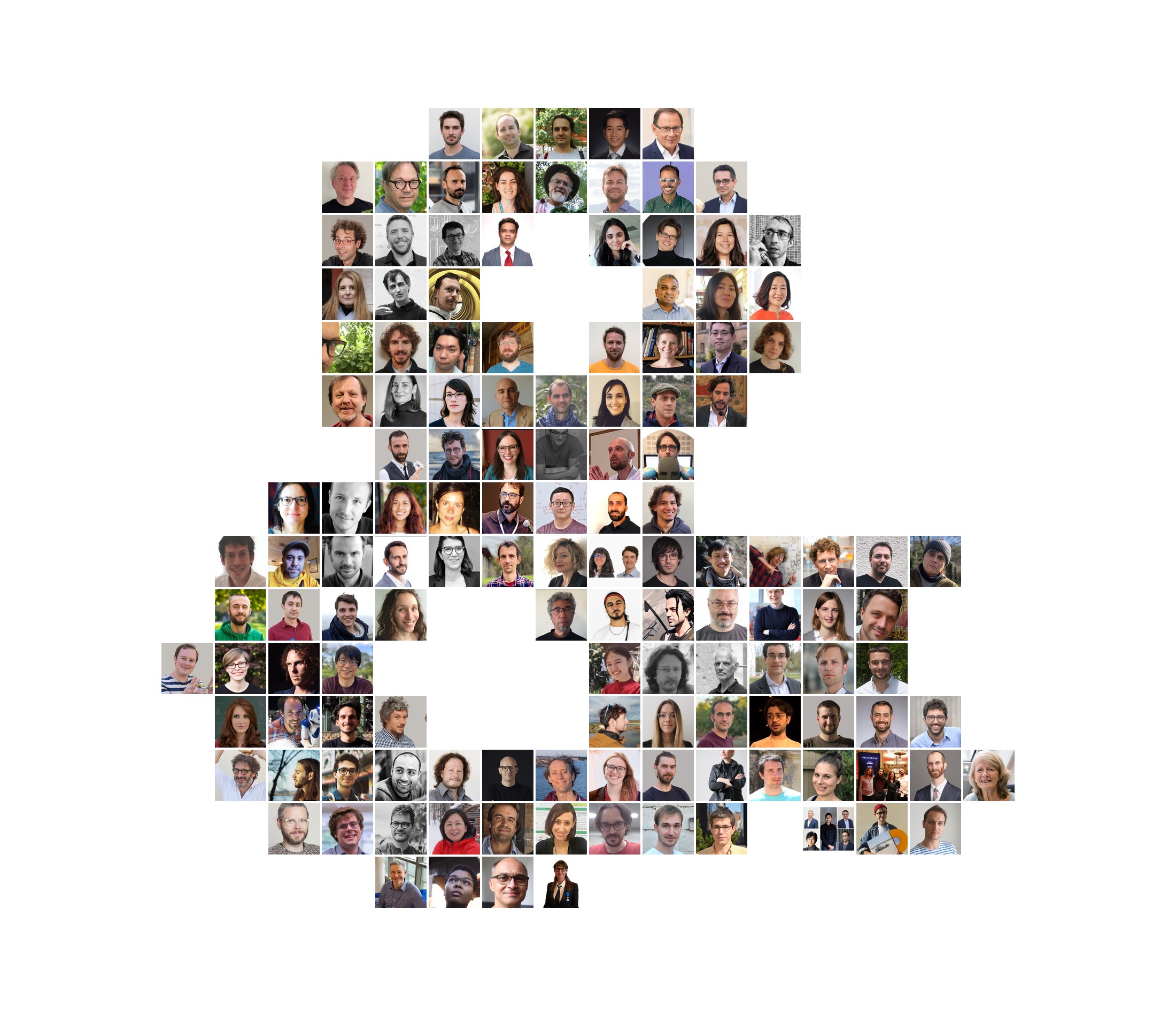
The mosaic above brings together 134 available portraits. It is an imperfect group photograph—some speakers are absent, while some seminars featured several people—but it captures the human richness of the series better than any single statistic.
A deliberately broad programme
Étincelle was built around curiosity rather than disciplinary boundaries. The largest group of talks concerned music and audio AI (26 seminars). Three other areas followed closely, with 24 seminars each: complex systems and society, machine learning and computing, and language and cognition.
The programme also gave substantial space to agriculture, ecology and the environment, art, creativity and the humanities, and life and physical sciences, with 17 seminars in each area. Innovation, industry and ethics accounted for 16 seminars, and robotics, embodiment and human–computer interaction for 12.
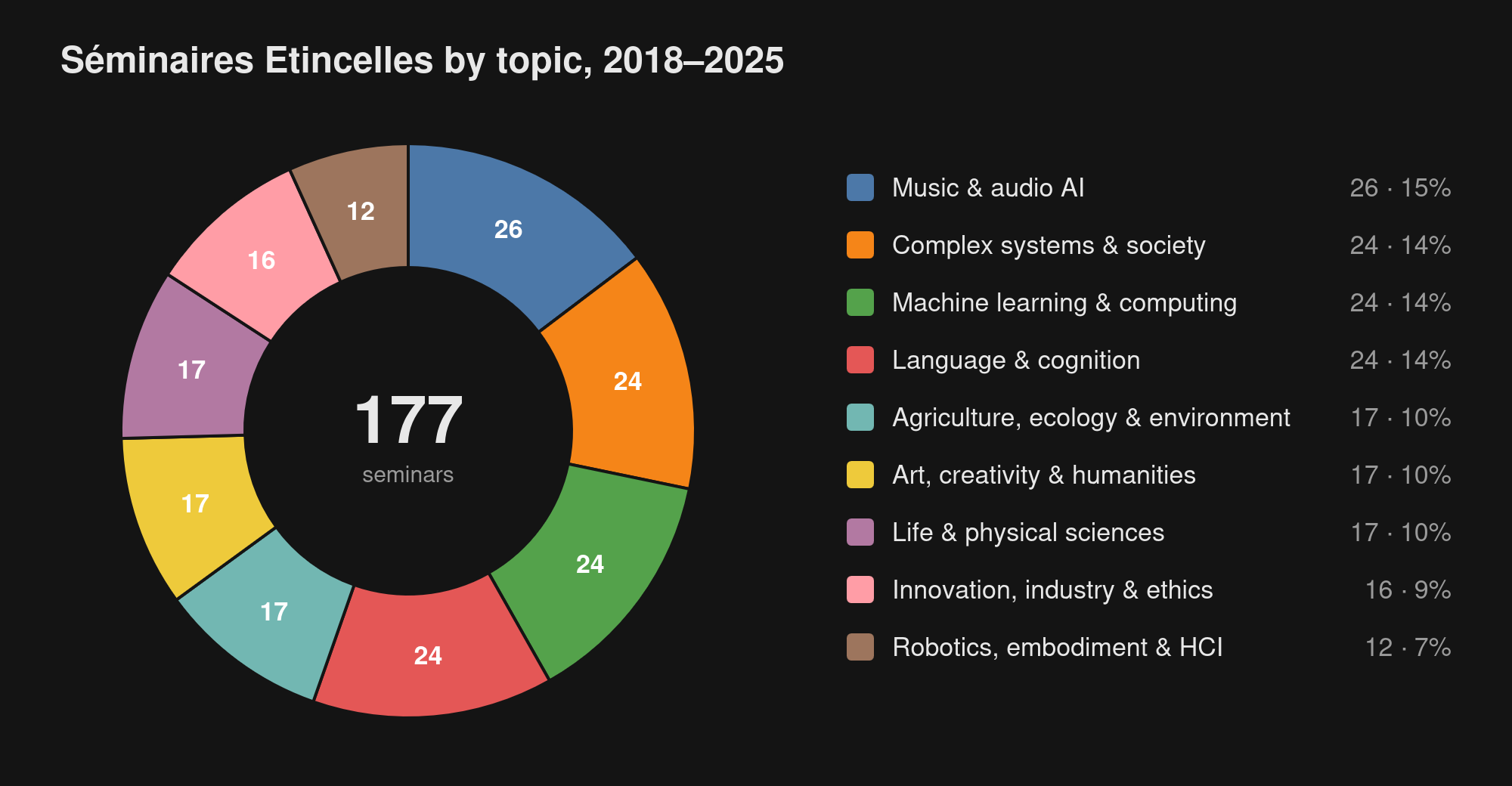
These categories are useful for seeing the overall balance, but they should not be mistaken for hard borders. Many seminars crossed several of them at once: music became a question of machine learning, biology met computation, agriculture connected with robotics, and creativity opened onto language, design and society.
A network reaching beyond Paris
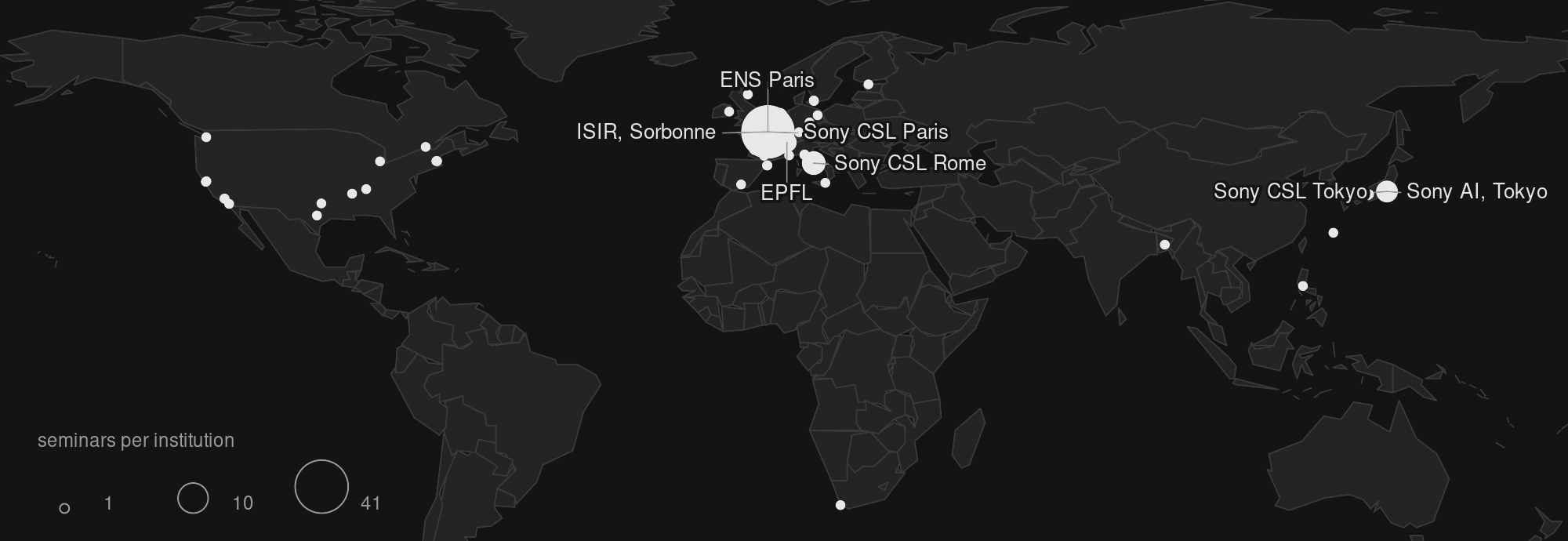
The affiliations of the speakers show how widely the series reached. While Paris and its surrounding research community formed its centre of gravity, guests also joined us from across Europe and from institutions in North America, Africa and Asia.
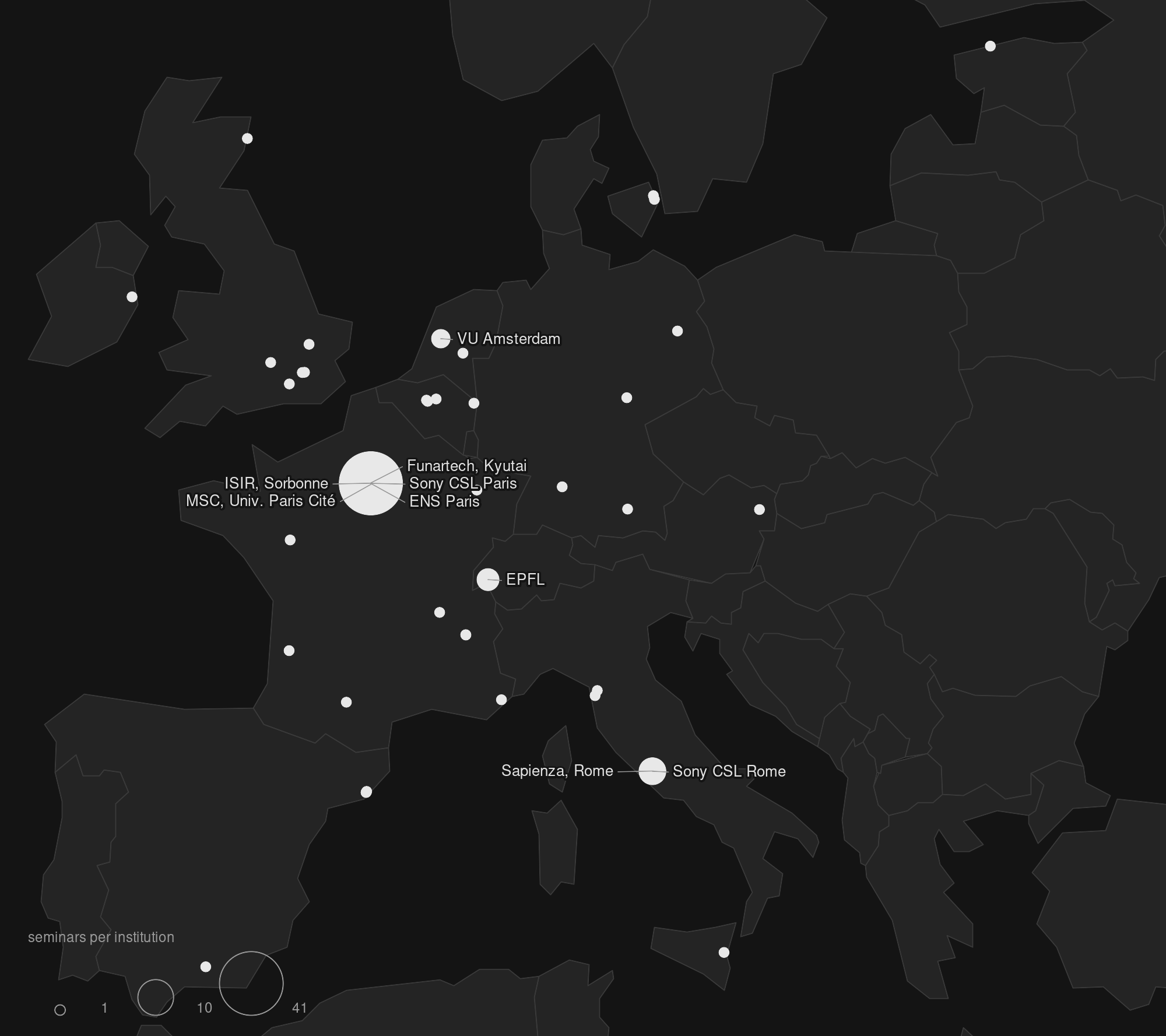
The European view makes the density of this network clearer. It reflects both strong local ties and a broader circulation of researchers and ideas across the continent.
The vocabulary of the series
The speaker biographies and abstracts offer another view of the programme. Their most frequent terms highlight a recurring interest in models, music, creativity, computation, data, machine learning, biology and physics.
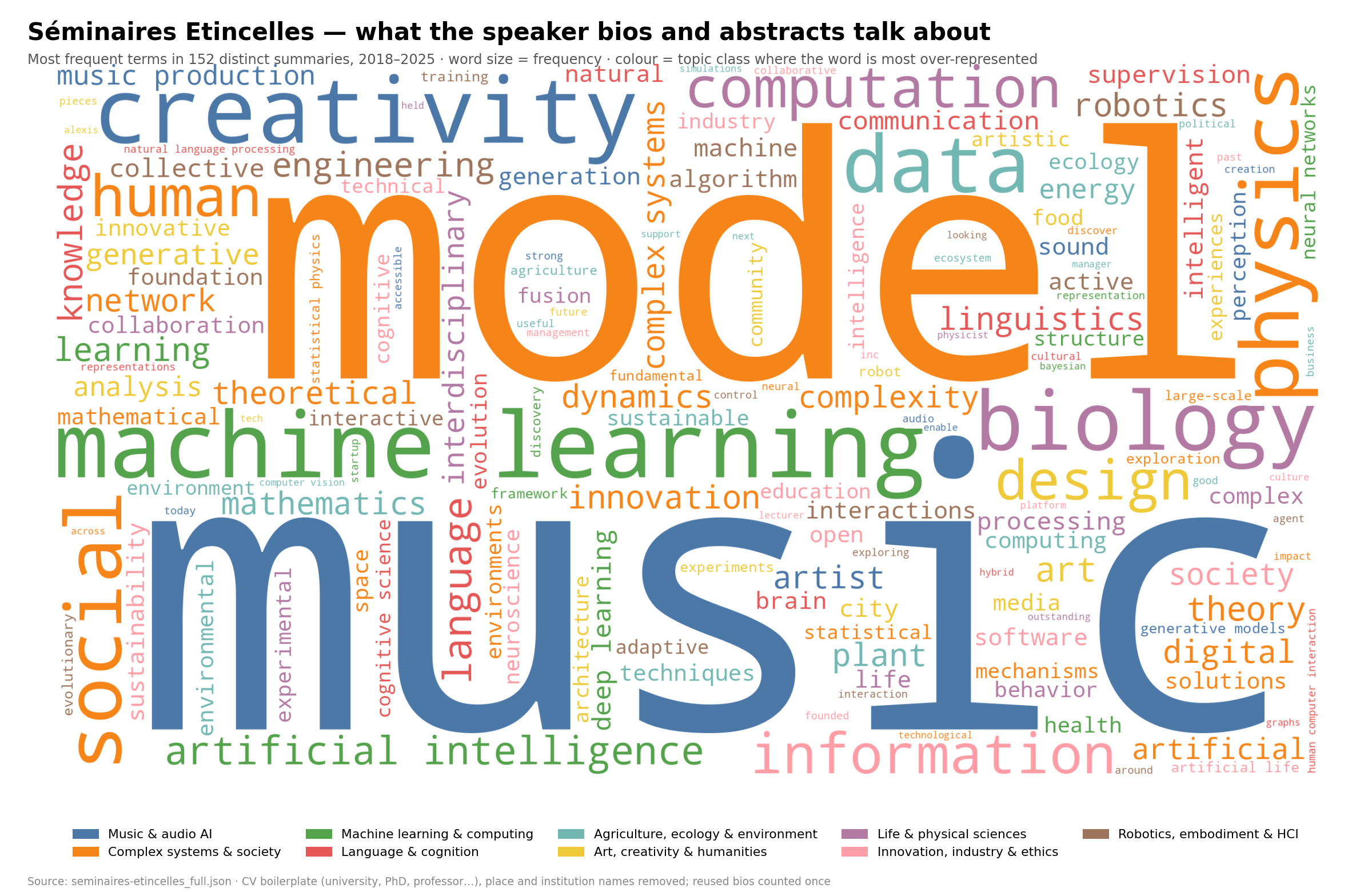
What I value most in this word cloud is not the dominance of any one term, but the coexistence of so many vocabularies. Across eight years, Étincelle created a place where methods and ideas could travel between communities—and where an unexpected connection could become the starting point for a new discussion.
The complete seminar archive is available on the Étincelle webpage, and recordings can be found in the Étincelle YouTube playlist.
Finally, many thanks to Sébastien Marino for his help in organizing these events.